Old Fashioned Communion Dresses for Girls Victorian Dresses


Illustration depicting fashions throughout the 19th century
Victorian fashion consists of the various fashions and trends in British culture that emerged and developed in the United kingdom and the British Empire throughout the Victorian era, roughly from the 1830s through the 1890s. The period saw many changes in fashion, including changes in styles, fashion technology and the methods of distribution. Various motion in architecture, literature, and the decorative and visual arts too as a irresolute perception of gender roles also influenced fashion.
Under Queen Victoria's reign, England enjoyed a catamenia of growth along with technological advancement. Mass product of sewing machines in the 1850s besides as the appearance of synthetic dyes introduced major changes in fashion.[1] Vesture could be fabricated more than quickly and cheaply. Advancement in printing and proliferation of fashion magazines immune the masses to participate in the evolving trends of high fashion, opening the market place of mass consumption and ad. By 1905, clothing was increasingly factory made and oftentimes sold in large, fixed-price department stores, spurring a new age of consumerism with the rise eye class who benefited from the industrial revolution.[1]
Women's fashions
During the Victorian Era, women generally worked in the individual, domestic sphere.[2] Unlike in before centuries when women would oft assistance their husbands and brothers in family businesses and in labour, during the nineteenth century, gender roles became more divers. The requirement for farm labourers was no longer in such a loftier demand after the Industrial Revolution, and women were more likely to perform domestic work or, if married, give up work entirely. Dress reflected this new, increasingly sedentary lifestyle, and was not intended to be commonsensical.
Clothes were seen as an expression of women'southward place in order,[3] hence were differentiated in terms of social class. Upper-class women, who did not need to work, oft wore a tightly laced corset over a bodice or chemisette, and paired them with a brim adorned with numerous embroideries and trims; over layers of petticoats. Middle-class women exhibited like dress styles; however, the decorations were not as improvident. The layering of these garments make them very heavy. Corsets were likewise stiff and restricted move. Although the wearing apparel were not comfortable, the type of fabrics and the numerous layers were worn every bit a symbol of wealth.
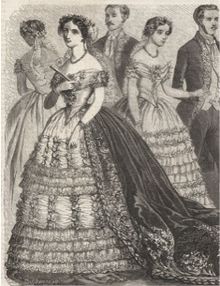
Moving picture of 1850s evening dress with a bertha neckline
- Neck-line: Bertha is the low shoulder neck-line worn by women during the Victorian Era. The cut exposed a woman'south shoulders and it sometimes was trimmed over with a three to half-dozen-inch deep lace flounce, or the bodice has neckline draped with several horizontal bands of material pleats. However, the exposure of neck-line was only restricted to the upper and middle form, working-course women during the fourth dimension period were not allowed to reveal then much flesh.
The décolleté style made shawls to get an essential feature of dresses. Corsets lost their shoulder straps, and fashion was to produce two bodices, ane airtight décolletage for 24-hour interval and one décolleté for evening. - Boning: Corsets were used in women's gowns for emphasizing the small waist of the female person body. They function as an undergarment which tin can be adjusted to bind tightly around the waist, hold and railroad train a person's waistline, so to slim and adjust it to a fashionable silhouette. It too helped cease the bodice from horizontal creasing. With the corset, a very small tight fitting waist would be shown.
Corsets have been blamed for causing many diseases because of tight lacing, only the practice was less commonplace than mostly idea today (Effects of tightlacing on the trunk).

- Sleeves: Sleeves were tightly fit during the early on Victorian era. Information technology matched with the tight fit women'south modest waist in the design, and the shoulder sleeve seamline was drooped more to show a tighter fit on the arm. This eventually express women'south movements with the sleeves.
However, as crinolines started to develop in style, sleeves turned to be like large bells which gave the apparel a heavier volume. Engageantes, which were usually made of lace, linen, or backyard, with cambric and broderie anglaise, were worn under the sleeves. They were easy to remove, launder and restitch into position, so to act as false sleeves, which was tacked to the elbow-length sleeves during the time. They normally appear under the bong-shaped sleeves of 24-hour interval dresses. - Silhouette: Silhouette changed over fourth dimension supported past the evolution of the undergarment. In before days, wide skirts were supported by fabrics like linen which used horsehair in the weave. Crinolines were used to give skirts a beehive shape, with at least 6 layers petticoats worn under the skirt, which could weigh as much as fourteen pounds. Later, the muzzle crinoline was developed. Women were freed from the heavy petticoats, and were able to move their legs freely below the cage. Silhouette later began to emphasise a gradient toward the back of the skirt. Polonaise manner was introduced where fullness bunched up at the back of the skirt. Crinolines and cages also started to disappear with it being more dangerous to working-class women. Tournures or bustles were developed.
Victorian-era cosmetics were typically minimal, as makeup was associated with promiscuity. Many cosmetics contained toxic or caustic ingredients like lead, mercury, ammonia, and arsenic.
1830s wearing apparel style
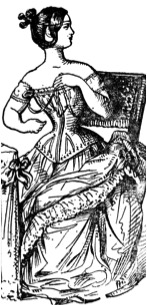
During the offset of Queen Victoria'south reign in 1837, the ideal shape of the Victorian adult female was a long slim trunk emphasised past wide hips. To achieve a low and slim waist, corsets were tightly laced and extended over the abdomen and downward towards the hips.[iv] A chemise was usually worn under the corset, and cut relatively low in order to foreclose exposure. Over the corset, was the tight-fitting bodice featuring a low waistline. Along with the bodice was a long skirt, featuring layers of horsehair petticoats[4] worn underneath to create fullness; while placing emphasis on the modest waist. To contrast the narrow waist, low and straight necklines were thus used.
1840s wearing apparel style
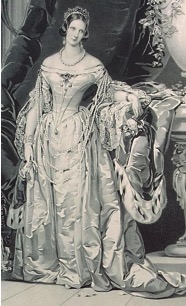
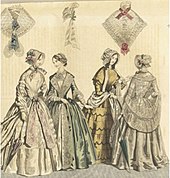
In the 1840s, collapsed sleeves, low necklines, elongated V-shaped bodices, and fuller skirts characterised the dress styles of women.
At the start of the decade, the sides of bodices stopped at the natural waistline, and met at a point in the front. In accord with the heavily boned corset and seam lines on the bodice equally well, the popular low and narrow waist was thus accentuated.
Sleeves of bodices were tight at the top, considering of the Mancheron,[five] but expanded around the expanse between the elbow and before the wrist. Information technology was besides initially placed below the shoulder, however; this restricted the movements of the arm.[v]
As a result, the center of the decade saw sleeves flaring out from the elbow into a funnel shape; requiring undersleeves to exist worn in social club to encompass the lower arms.[6]
Skirts lengthened, while widths increased due to the introduction of the horsehair crinoline in 1847; becoming a status symbol of wealth.
Extra layers of flounces and petticoats, also farther emphasised the fullness of these wide skirts. In compliance with the narrow waist though, skirts were therefore attached to bodices using very tight organ pleats secured at each fold.[5] This served as a decorative element for a relatively plain brim. The 1840s style was perceived as conservative and "Gothic" compared to the flamboyance of the 1830s.[7]
1850s wearing apparel style

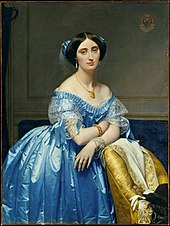

A like silhouette remained in the 1850s, while certain elements of garments inverse.
Necklines of day dresses dropped even lower into a Five-shape, causing a need to cover the bust area with a chemisette. In contrast, evening dresses featured a Bertha, which completely exposed the shoulder surface area instead. Bodices began to extend over the hips, while the sleeves opened farther and increased in fullness. The volume and width of the brim continued to increase, particularly during 1853, when rows of flounces were added.
All the same, in 1856, skirts expanded even further; creating a dome shape, due to the invention of the first artificial cage crinoline. The purpose of the crinoline was to create an bogus hourglass silhouette by accentuating the hips, and fashioning an illusion of a small waist; along with the corset. The cage crinoline was synthetic by joining thin metal strips together to form a round structure that could solely back up the large width of the skirt. This was made possible past technology which allowed iron to exist turned into steel, which could then be drawn into fine wires.[1] Although often ridiculed by journalists and cartoonists of the fourth dimension as the crinoline swelled in size, this innovation freed women from the heavy weight of petticoats and was a much more than aseptic selection.[7]
Meanwhile, the invention of synthetic dyes added new colours to garments and women experimented with gaudy and vivid colours. Technological innovation of 1860s provided women with freedom and choices.[1]
1860s clothes way
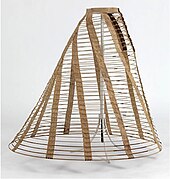

1860s dress featuring a train
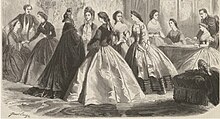
During the early and middle 1860s, crinolines began decreasing in size at the peak, while retaining their amplitude at the bottom.[8] In contrast, the shape of the crinoline became flatter in the front and more voluminous behind, as it moved towards the back since skirts consisted of trains now. Bodices on the other hand, ended at the natural waistline, had wide pagoda sleeves, and included high necklines and collars for day dresses; low necklines for evening dresses. However, in 1868, the female silhouette had slimmed down as the crinoline was replaced by the bustle, and the supporting flounce overtook the role of determining the silhouette.[9] Skirt widths diminished even further, while fullness and length remained at the back. In club to emphasise the back, the railroad train was gathered together to grade soft folds and draperies[10]
1870s dress style
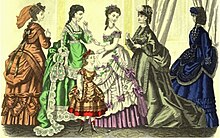
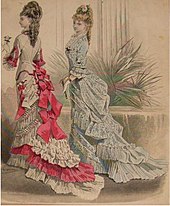
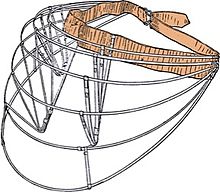
The trend for broad skirts slowly disappeared during the 1870s, equally women started to prefer an even slimmer silhouette. Bodices remained at the natural waistline, necklines varied, while sleeves began under the shoulder line. An overskirt was unremarkably worn over the bodice, and secured into a large bow behind. Over time though, the overskirt shortened into a detached basque, resulting in an elongation of the bodice over the hips. Every bit the bodices grew longer in 1873, the polonaise was thus introduced into the Victorian dress styles. A polonaise is a garment featuring both an overskirt and bodice together. The tournure was also introduced, and along with the polonaise, information technology created an illusion of an exaggerated rear finish.
By 1874, skirts began to taper in the front and were adorned with trimmings, while sleeves tightened effectually the wrist area. Towards 1875 to 1876, bodices featured long just even tighter laced waists, and converged at a sharp signal in front. Bustles lengthened and slipped fifty-fifty lower, causing the fullness of the skirt to farther diminish. Extra textile was gathered together behind in pleats, thus creating a narrower simply longer tiered, draped train too. Due to the longer trains, petticoats had to be worn underneath in order to go along the apparel clean.
However, when 1877 approached, dresses moulded to fit the effigy,[viii] as increasing slimmer silhouettes were favoured. This was allowed by the invention of the cuirass bodice which functions like a corset, but extends downwards to the hips and upper thighs. Although dress styles took on a more natural form, the narrowness of the skirt express the wearer in regards to walking.
1880s dress fashion
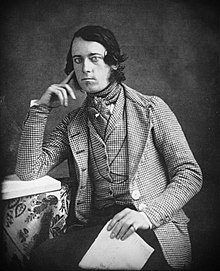
A Victorian dandy pictured in the 1840s

The early on 1880s was a flow of stylistic confusion.[1] On one manus, there is the over-ornamented silhouette with contrasting texture and frivolous accessories. On the other hand, the growing popularity of tailoring gave ascent to an alternative, severe manner.[7] Some credited the change in silhouette to the Victorian wearing apparel reform, which consisted of a few movements including the Artful Costume Movement and the Rational Dress Motility in the mid-to-tardily Victorian Era advocating natural silhouette, lightweight underwear, and rejecting tightlacing. However, these movements did not gain widespread back up. Others noted the growth in cycling and tennis as acceptable feminine pursuits that demanded a greater ease of movement in women'due south clothing.[i] Still others argued that the growing popularity of tailored semi-masculine suits was only a fashionable way, and indicated neither advanced views nor the need for practical clothes.[vii] Nonetheless, the diversification in options and adoption of what was considered menswear at that time coincided with growing power and social status of women towards the late-Victorian period.
The bustle made a re-appearance in 1883, and it featured a further exaggerated horizontal protrusion at the back. Due to the additional fullness, drapery moved towards the sides or front console of the skirt instead. Any drape at the back was lifted up into poufs. Bodices on the other hand, shortened and ended in a higher place the hips. Yet the style remained tailored, merely was more structured.
However, past 1886, the silhouette transformed back to a slimmer effigy once more. Sleeves of bodices were thinner and tighter, while necklines became higher again. Furthermore, an even further tailored-wait began to develop until it improved in the 1890s.
1890s dress style
By 1890, the crinoline and hurry was fully abandoned, and skirts flared away naturally from the wearer's tiny waist. Information technology evolved into a bong shape, and were made to fit tighter around the hip area. Necklines were high, while sleeves of bodices initially peaked at the shoulders, just increased in size during 1894. Although the big sleeves required cushions to secure them in place, information technology narrowed downwardly towards the end of the decade. Women thus adopted the fashion of the tailored jacket, which improved their posture and confidence, while reflecting the standards of early female person liberation.
Hats
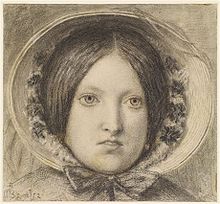

Hats were crucial to a respectable appearance for both men and women. To get bareheaded was simply not proper. The pinnacle hat, for example, was standard formal wear for upper- and middle-class men.[7] For women, the styles of hats inverse over time and were designed to match their outfits.
During the early on Victorian decades, voluminous skirts held up with crinolines, and and so hoop skirts, were the focal betoken of the silhouette. To enhance the way without distracting from it, hats were pocket-sized in size and design, straw and fabric bonnets beingness the popular choice. Poke bonnets, which had been worn during the late Regency period, had high, small crowns and brims that grew larger until the 1830s, when the face of a woman wearing a poke bonnet could only be seen directly from the front. They had rounded brims, echoing the rounded form of the bong-shaped hoop skirts.
The silhouette changed once again as the Victorian era drew to a close. The shape was essentially an inverted triangle, with a wide-brimmed lid on top, a full upper body with puffed sleeves, no bustle, and a skirt that narrowed at the ankles[11] (the hobble skirt was a fad shortly later on the end of the Victorian era). The enormous wide-brimmed hats were covered with elaborate creations of silk flowers, ribbons, and in a higher place all, exotic plumes; hats sometimes included entire exotic birds that had been blimp. Many of these plumes came from birds in the Florida everglades, which were nearly fabricated entirely extinct past overhunting. Past 1899, early environmentalists similar Adeline Knapp were engaged in efforts to curtail the hunting for plumes. By 1900, more than than v million birds a year were beingness slaughtered, and nearly 95 percent of Florida'south shore birds had been killed by plume hunters.[12]
Shoes
The women's shoes of the early Victorian catamenia were narrow and heelless, in black or white satin. By 1850s and 1860s, they were slightly broader with a low heel and made of leather or fabric. Talocrural joint-length laced or buttoned boots were as well popular. From the 1870s to the twentieth century, heels grew higher and toes more pointed. Depression-cut pumps were worn for the evening.[7]
Men's fashion

Drawing of Victorian men 1870s
During the 1840s, men wore tight-fitting, calf length frock coats and a waistcoat or vest. The vests were single- or double-breasted, with shawl or notched collars, and might be finished in double points at the lowered waist. For more formal occasions, a cutaway morn coat was worn with lite trousers during the daytime, and a nighttime tail coat and trousers was worn in the evening. Shirts were made of linen or cotton with low collars, occasionally turned downwards, and were worn with wide cravats or neck ties. Trousers had fly fronts, and breeches were used for formal functions and when horseback riding. Men wore height hats, with wide brims in sunny weather.
During the 1850s, men started wearing shirts with high upstanding or turnover collars and 4-in-mitt neckties tied in a bow, or tied in a knot with the pointed ends sticking out similar "wings". The upper-course continued to wear tiptop hats, and bowler hats were worn past the working course.
In the 1860s, men started wearing wider neckties that were tied in a bow or looped into a loose knot and fastened with a stickpin. Frock coats were shortened to human knee-length and were worn for business, while the mid-thigh length sack coat slowly displaced the frock coat for less-formal occasions. Pinnacle hats briefly became the very alpine "stovepipe" shape, just a variety of other hat shapes were popular.
During the 1870s, 3-piece suits grew in popularity forth with patterned fabrics for shirts. Neckties were the 4-in-hand and, after, the Ascot ties. A narrow ribbon necktie was an alternative for tropical climates, particularly in the Americas. Both apron coats and sack coats became shorter. Flat straw boaters were worn when boating.
During the 1880s, formal evening dress remained a dark tail coat and trousers with a nighttime waistcoat, a white bow tie, and a shirt with a winged collar. In mid-decade, the dinner jacket or tuxedo, was used in more relaxed formal occasions. The Norfolk jacket and tweed or woolen breeches were used for rugged outdoor pursuits such as shooting. Knee-length topcoats, often with contrasting velvet or fur collars, and calf-length overcoats were worn in winter. Men'due south shoes had higher heels and a narrow toe.
Starting from the 1890s, the blazer was introduced, and was worn for sports, sailing, and other casual activities.[thirteen]
Throughout much of the Victorian era most men wore fairly short hair. This was frequently accompanied by diverse forms of facial hair including moustaches, side-burns, and full beards. A make clean-shaven confront did not come dorsum into fashion until the terminate of the 1880s and early on 1890s.[14]
Distinguishing what men really wore from what was marketed to them in periodicals and advertisements is problematic, equally reliable records do not exist.[fifteen]
Mourning black

Victoria'south v daughters (Alice, Helena, Beatrice, Victoria and Louise), photographed wearing mourning black below a bust of their late father, Prince Albert (1862)
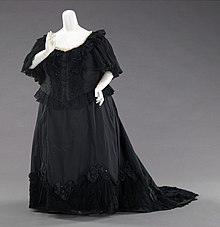
In Britain, black is the colour traditionally associated with mourning for the dead. The community and etiquette expected of men, and especially women, were rigid during much of the Victorian era. The expectations depended on a complex hierarchy of close or distant relationship with the deceased. The closer the relationship, the longer the mourning menstruum and the wearing of black. The wearing of full blackness was known every bit Starting time Mourning, which had its own expected attire, including fabrics, and an expected duration of 4 to 18 months. Post-obit the initial flow of First Mourning, the mourner would progress to 2nd Mourning, a transition period of wearing less black, which was followed by Ordinary Mourning, then One-half-mourning. Some of these stages of mourning were shortened or skipped completely if the mourner's relationship to the deceased was more distant. Half-mourning was a transition menses when black was replaced by adequate colours such as lavander and mauve, perchance considered acceptable transition colours because of the tradition of Church building of England (and Catholic) clergy wearing lavender or mauve stoles for funeral services, to correspond the Passion of Christ.[sixteen]
The mourning dress on the correct was worn by Queen Victoria, "information technology shows the traditional touches of mourning attire, which she wore from the decease of her husband, Prince Albert (1819–1861), until her ain death."[17]
Norms for mourning
Manners and Rules of Proficient Guild, or, Solecisms to be Avoided (London, Frederick Warne & Co., 1887) gives articulate instructions, such equally the following:[18]
| Relationship to deceased | Kickoff mourning | Second mourning | Ordinary mourning | Half-mourning |
|---|---|---|---|---|
| Wife for husband | one-yr, 1-calendar month; bombazine fabric covered with crepe; widow's cap, backyard cuffs, collars | 6 months: less crepe | 6 months: no crepe, silk or wool replaces bombazine; in last iii months jet jewellery and ribbons can be added | 6 months: colours permitted are grey, lavander, mauve, and black-and-grey |
| Daughter for parent | 6 months: black with blackness or white crepe (for immature girls); no linen cuffs and collars; no jewellery for showtime ii months | iv months: less crepe | – | 2 months every bit in a higher place |
| Wife for married man'due south parents | 18 months in black bombazine with crepe | – | iii months in black | iii months as above |
| Parent for son- or daughter-in-law'southward parent | – Black armband in representation of someone lost | – | 1-month blackness | – |
| 2nd married woman for parent of a first wife | – | – | 3 months black | – |
The complexity of these etiquette rules extends to specific mourning periods and attire for siblings, footstep-parents, aunts and uncles distinguished by blood and by marriage, nieces, nephews, first and second cousins, children, infants, and "connections" (who were entitled to ordinary mourning for a period of "1–3 weeks, depending on level of intimacy"). Men were expected to wearable mourning black to a lesser extent than women, and for a shorter mourning period. After the mid-19th century, men would clothing a blackness hatband and black adapt, merely for only half the prescribed period of mourning expected of women. Widowers were expected to mourn for a mere three months, whereas the proper mourning menstruum expected for widows was up to four years.[19] Women who mourned in black for longer periods were accorded swell respect in public for their devotion to the departed, the most prominent example being Queen Victoria herself.
Women with lesser financial means tried to continue up with the example being set by the center and upper classes by dyeing their daily dress. Dyers made most of their income during the Victorian menstruation by dyeing clothes blackness for mourning.[20]
Technological advancement
Technological advancements non only influenced the economy merely brought a major change in the fashion styles worn by men and women. Equally the Victorian era was based on the principles of gender, race and class.[21] Much advancement was in favor of the upper class as they were the ones who could afford the latest technology and change their fashion styles accordingly. In 1830s there was introduction of horse hair crinoline that became a symbol of status and wealth as only the upper-course women could wear it. In 1850s there were more fashion technological advancements hence 1850s could rightly be called a revolution in the Victorian fashion industry such as the innovation of artificial muzzle crinoline that gave women an artificial hourglass silhouette this meant that women did non have to article of clothing layers of petticoats anymore to achieve illusion of wide hips and it was too hygienic.[22] Constructed dyes were too introduced that added new bright colours to garments. These technological advancement gave women freedom and choices. In 1855'south Haute couture was introduced as tailoring became more mainstream in years to follow.[23]
Charles Frederick Worth, a prominent English designer, became popular amongst the upper class though its city of destiny ever is Paris. Haute couture became popular at the same time when sewing machines were invented.[24] Hand sewn techniques arose and were a distinction in compared to the old ways of tailoring. Princess Eugenie of French republic wore the Englishman dressmaker, Charles Frederick Worth's couture and he instantly became famous in French republic though he had just arrived in Paris a few years ago. In 1855, Queen Victoria and Prince Albert of Britain welcomed Napoleon 3 and Eugenie of France to a total state visit to England. Eugenie was considered a manner icon in French republic. She and Queen Victoria became instant friends. Queen Victoria, who had been the fashion icon for European loftier mode, was inspired past Eugenie'south mode and the fashions she wore. Later Queen Victoria also appointed Charles Frederick Worth as her clothes maker and he became a prominent designer among the European upper class. Charles Frederick Worth is known as the father of the haute couture every bit later the concept of labels were also invented in the late 19th century as custom, made to fit tailoring became mainstream.[25]
By the 1860s, when Europe was all nigh made-to-fit tailoring, crinolines were considered impractical. In the 1870s, women preferred more slimmer silhouettes, hence bodices grew longer and the polonaise, a skirt and bodice made together, was introduced. In 1870s the Cuirass Bodice, a slice of armour that covers the torso and functions similar a corset, was invented. Towards the end of Victoria's reign, dresses were flared naturally as crinolines were rejected by middle-class women. Designers such as Charles Frederick Worth were likewise against them. All these inventions and changes in fashion led to women's liberation as tailored looks improved posture and were more practical.[24]
Home décor
Home decor started spare, veered into the elaborately draped and busy style we today regard as Victorian, so embraced the retro-chic of William Morris besides as pseudo-Japonaiserie.
Contemporary stereotypes
Victorian Modesty

"The proper length for little girls' skirts at various ages", from Harper's Bazaar, showing a 1900 thought of how the hemline should descend towards the ankle every bit a daughter got older
Many myths and exaggerations near the period persist to the modern twenty-four hour period. Examples include the idea of men'due south clothing is seen as formal and stiff, women'due south as elaborate and over-done; clothing covered the entire body, and fifty-fifty the glimpse of an ankle was scandalous. Critics contend that corsets constricted women'southward bodies and women's lives. Homes are described as gloomy, dark, chaotic with massive and over-ornate furniture and proliferating bric-a-brac. Myth has it that fifty-fifty piano legs were scandalous, and covered with tiny pantalettes.
In truth, men's formal clothing may have been less colourful than it was in the previous century, merely brilliant waistcoats and cummerbunds provided a touch of color, and smoking jackets and dressing gowns were ofttimes of rich Oriental brocades. This miracle was the effect of the growing fabric manufacturing sector, developing mass production processes, and increasing attempts to market mode to men.[15] Corsets stressed a adult female's sexuality, exaggerating hips and bust past dissimilarity with a tiny waist. Women's evening gowns bared the shoulders and the tops of the breasts. The jersey dresses of the 1880s may have covered the trunk, but the stretchy novel material fit the body like a glove.[26]
Home furnishing was not necessarily ornate or overstuffed. Yet, those who could afford lavish draperies and expensive ornaments, and wanted to display their wealth, would often practice so. Since the Victorian era was one of increased social mobility, at that place were e'er more than nouveaux riches making a rich show.
The items used in ornament may as well take been darker and heavier than those used today, simply as a affair of practicality. London was noisy and its air was full of soot from countless coal fires. Hence those who could afford it draped their windows in heavy, audio-muffling curtains, and chose colours that didn't show soot rapidly. When all washing was washed by hand, defunction were not washed equally frequently as they might be today.
In that location is no bodily evidence that pianoforte legs were considered scandalous. Pianos and tables were often draped with shawls or cloths—but if the shawls hid anything, it was the cheapness of the furniture. In that location are references to lower-center-class families roofing up their pine tables rather than prove that they couldn't afford mahogany. The pianoforte leg story seems to have originated in the 1839 volume, A Diary in America written by Captain Frederick Marryat, equally a satirical comment on American prissiness.[27]
Victorian manners may have been as strict as imagined—on the surface. One simply did non speak publicly about sex, childbirth, and such matters, at to the lowest degree in the respectable center and upper classes. However, every bit is well known, discretion covered a multitude of sins. Prostitution flourished. Upper-class men and women indulged in cheating liaisons.
Gallery
-

A mid-Victorian interior: Hibernate and Seek by James Tissot, c. 1877
-
-

-

-
Run into besides
- Victorian clothes reform
- Women in the Victorian Era
- Victorian morality
- Charles Frederick Worth
- Victorian decorative arts
- Victoriana
Time periods
- 1830s in fashion
- 1840s in style
- 1850s in fashion
- 1860s in fashion
- 1870s in manner
- 1880s in fashion
- 1890s in mode
Women's clothing
- Corset
- Corset controversy
- Tightlacing
- Bloomers
- Bodice
Contemporary interpretations
- Steampunk
- Neo-Victorian
- Lolita
References
- ^ a b c d e f Breward, Christopher (1995). The Culture of Fashion. Manchester University Press. pp. 145–180.
- ^ "Gender roles in the 19th century". The British Library . Retrieved 21 Oct 2016.
- ^ Gernsheim, Alison (1963). Victorian and Edwardian Fashion - A Photographic Survey. New York: Dover Publications Inc. p. 26.
- ^ a b Goldthorpe, Caroline (1988). From Queen to Empress - Victorian Apparel 1837-1877. New York: The Metropolitan Museum of Art. pp. 23–24.
- ^ a b c Goldthorpe, Caroline (1988). From Queen to Empress - Victorian Wearing apparel 1837-1877. New York: The Metropolitan Museum of Art. p. 32.
- ^ Goldthorpe, Caroline (1988). From Queen to Empress - Victorian Dress 1837-1877. New York: The Metropolitan Museum of Fine art. p. 39.
- ^ a b c d eastward f Steele, Valerie (1985). Victorian Fashion. Style and Eroticism: Ethics of Feminine Dazzler from the Victorian Era to the Jazz Age . Oxford Academy Press. pp. 51–84. ISBN978-0-19-503530-viii.
- ^ a b Goldthorpe, Caroline (1988). From Queen to Empress - Victorian Wearing apparel 1837-1877. New York: The Metropolitan Museum of Fine art. p. 26.
- ^ Goldthorpe, Caroline (1988). From Queen to Empress - Victorian Wearing apparel 1837-1877. New York: The Metropolitan Museum of Art. p. 45.
- ^ Audin, Heather (2015). Making Victorian Costumes for Women. Crowood. p. 45.
- ^ Laver, James (2002). Costume and Fashion: A Concise History. London: Thames & Hudson Ltd. pp. 224–5. ISBN978-0-500-20348-4.
- ^ "Everglades National Park". PBS. Retrieved seven November 2011.
- ^ Landow, George. "Men's informal sporting clothes, late 1880s and '90s".
- ^ "Victorian Men's Fashions, 1850–1900: Hair".
- ^ a b Shannon, Brent (2004). "Refashioning Men: Mode, Masculinity, and the Tillage of the Male Consumer in Britain, 1860–1914". Victorian Studies. 46 (four): 597–630. doi:10.1353/vic.2005.0022.
- ^ "The Colors of the Church Year". Consortium of State Churches. Retrieved 6 November 2011.
- ^ The Metropolitan Museum of Art (seven September 2019). "Mourning Dress, 1894–95". The Metropolitan Museum of Fine art . Retrieved vii September 2019.
- ^ Flanders, Judith (2003). The Victorian House. London: Harper Perennial. pp. 378–83. ISBN0-00-713189-v.
- ^ Flanders, Judith (2003). The Victorian House. London: Harper Perennial. pp. 378–9. ISBN0-00-713189-v.
- ^ Flemish region, Judith (2003). The Victorian House. London: Harper Perennial. p. 341. ISBN0-00-713189-5.
- ^ Graham, P. "The Victorian Era". Digital Library of India.
- ^ Shrimpton, J. Victorian Fashion. Bloomsbury Shire Publications.
- ^ Aspelund, Karl. Fashioning Lodge. Fairchild Books.
- ^ a b Martin, Richard; Koda, Harold. Haute Couture. The Metropolitan Museum of Art.
- ^ Saillard, Olivier; Zazzo, Anne. Paris Haute Couture. Skira Flammarion.
- ^ Gernsheim, Alison (1981). Victorian & Edwardian Fashion: A Photographic Survey (New ed.). New York: Dover Publications. p. 65. ISBN0-486-24205-half-dozen.
- ^ Marryat, C.B. (1839). A Diary in America: With Remarks on Its Institutions. Vol. two. London, England: Longman, Orme, Brown, Green, and Longmans. pp. 246–247. From pp. 246-247: "I was requested by a lady to escort her to a seminary for immature ladies, and on being ushered into the reception-room, conceive my astonishment at beholding a foursquare pianoforte-forte with four limbs. However, that the ladies who visited their daughters, might feel in its full force the extreme delicacy of the mistress of the establishment, and her care to preserve in their utmost purity the ideas of the young ladies under her charge, she had dressed all these four limbs in pocket-sized picayune trousers, with frills at the bottom of them!"
Further reading
- Phipps, Elena; et al. (1988). From Queen to Empress: Victorian dress 1837-1877 . New York: The Metropolitan Museum of Fine art. ISBN0870995340.
- Sweet, Matthew – Inventing the Victorians, St. Martin's Press, 2001 ISBN 0-312-28326-ane
External links
- Victorian Way
- VictorianVoices.internet – Manner manufactures and illustrations from Victorian periodicals; all-encompassing fashion image gallery
- Victorian myths
- Victorian fashion, etiquette, and sports
- Groundwork on "A Diary in America"
- Form and Fashion — the evolution of women's clothes during the 19th century (many photographs)
- Educational Game: Mix and Match — build a 19th-century wearing apparel using a virtual mannequin
- "Victorian Clothes". Fashion, Jewellery & Accessories. Victoria and Albert Museum. 14 January 2011. Retrieved 3 April 2011.
- Fashion detective: Fashion, Fiction and Forensics in nineteenth century Australian style on Culture Victoria
0 Response to "Old Fashioned Communion Dresses for Girls Victorian Dresses"
Post a Comment